MAY 21, 2026
Understanding “Otherness”
I’ve long been thinking about how the art world could actually become more decentralized, with fewer gatekeepers and genuine pluralism rooted in multiple centers and narratives in different parts of the world. It’s not a singular problem that one solution or innovative practice can solve, but a rather complex issue centered around the idea of coexistence with the “others” — how they, once alienated and marginalized, are understood, introduced, and perceived. Only once we reach a consensus on that issue can the power structure in the art ecosystem be shifted and decentralized.
The underlying dilemma, however, is that the more “otherness” is discussed and studied within European narratives, the more alienated the “others” become. Essentially, it’s a series of questions that await redefinition or answers: Who are the “others”? What constitutes the “right” representation of the others? Has tolerance for the otherness grown in the West over the past decades, or have the boundaries between cultures and arts become more rigid? And is it truly possible to understand fundamentally different others?
The Right Portrayal of Otherness?
The dilemma, as mentioned before, can be easily observed not just in Eurocentric contemporary art scenes but also in various aspects of our contemporary life. What does all the inclusion and diversity training in institutions and corporations actually achieve?
The attempt to include the “others” and the growing obsession with cultural diversity as part of decolonizing efforts have resulted in further "othering” of some groups, and has led to strong rejection towards open communication, new arts, and cultures.
"The European psyche is incurably torn between moral superiority and paranoid fear of the other…"
--"Art Power" by Boris Groys
Boundaries have been crossed and blurred intentionally, but not eliminated. Therefore, one can’t help but wonder what the right way is to introduce the “others” and their cultures, artistic practices. What language should we use, and what identity should they adopt? Essentially, what are the correct representations of the “others”?
Looking back at institutions’ initial attempts to decolonize themselves around the 1980s, during the emergence of these politicized areas of humanistic studies, it would seem almost too clumsy and politically correct, and almost unsuccessful in their efforts to promote inclusion. By selecting identifiable cultural “others” and carefully creating new categories and labels for them, they only made themselves more distinct from the others.
Jumping back to today’s international contemporary art scenes, where a large number of artists from the global south (underdeveloped areas in Africa, Latin America, Asia, and Oceania, often marked by a colonial legacy) manipulate materials in similar ways to cater to an international art market taste. Do these works represent cultural otherness in a "just" way?
Traditional or not, provocative or not, it all belongs to their storytelling that reveals a uncomfortable truth for us to sit with, that is culture is more fluid and self-transformative than one might expect. Contrary to what some might argue, I’d say that perpetuating a stiff, stereotypical cultural identity is much harder in today’s society, which is constantly critical of its own past. At this point, no one can really define what oceanic art should look like, or what oriental art should look like, just as no one can give a universal definition of what art is. This indeed might risk creating more confusion for those who are not in the industry and are not familiar with all the narrative changes. But like many other similar issues we encounter in life that are never black and white, the solution might just be us stoping the search for a perfect representation or categorization for the otherness.
‘Foreigners Everywhere’, The Biennales, and Decolonial Practice
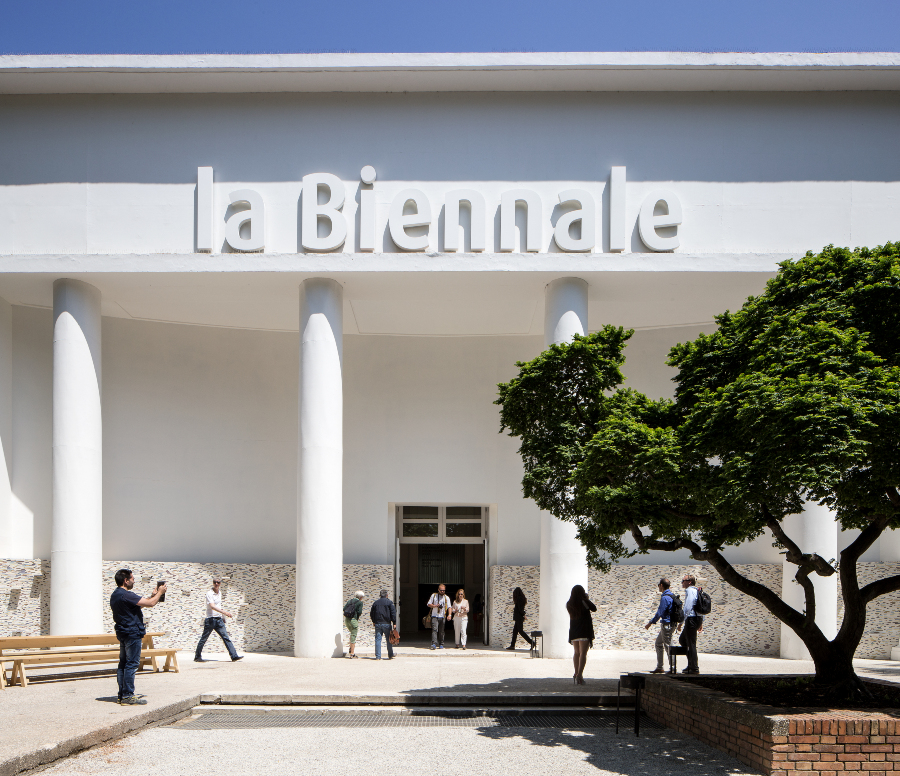
The 60th Venice Biennale, which opened last month, continued its discussion and exploration of the arts of ‘others’ — a theme that has become common to most biennales and other major art events. The theme is direct and provocative, titled “Foreigners Everywhere”. Two years ago, when I visited Documenta 15 in Kassel, I had the same feeling that Olu Oguibe expressed in his 2019 article: that not much has really changed, and that biennales of this sort end up consolidating the center position of old centers for art and culture, such as Venice. Later, I realized that such thinking can easily lead to a state of paralysis where doing anything would be futile unless we undo art history entirely. My stance right now is closer to what Maximilíano Durón commented in his review of the 60th Venice Biennale:
"Showcasing the work of dozens of Indigenous artists and artists from the Global South itself is not necessarily a decolonial practice — the Biennale isn’t divesting itself from the current biennial model, even if some of the artists seek to do so. Rather, I think it’s an effort to expand the canon and the purview of all who attend. That in itself is a cause that shouldn’t be taken for granted or dismissed."
It is progress in itself that we are able to see artworks from artists we might otherwise never know of in the absence of these institutional events.
The Politicization of Art, Space, and Everything
Art related to global south might come off as too political for many, and even the discussion of “otherness” is actually an integral part of the political narratives within postcolonial studies. For those who have not yet realized, art and exhibition have always been political. As Groys stated in “Art Power,” the work of art is a statement in public space; the exhibition space is always a narrative space.
An employee of documenta 15 covers the anti-semitism work by Taring Padi. Image © dpa
Earlier, we saw Indonesian artist Taring Padi’s work “People’s Justice” (2002) being taken down during Documenta 15 due to its anti-Semitic visual presentation. Now, we have an Israeli artist and curator deciding to close down the Israeli pavilion at the ongoing Venice Biennale until we achieve a ceasefire. What’s irritating is not the politicalness of art exhibitions and spaces, nor the artists’ intentions to be political in their works. It’s the influence on individuals who view and experience artwork without necessarily wanting to take sides on a political matter but feel pressured to do so. The viewing, creating, or judging of artwork belongs to individual behaviors that occur in private space and should therefore remain personal choices free from societal pressure or influence.
Protestors climb Jeffrey Gibson’s sculptures outside of the U.S. pavilion. Photo by John Holten.
The overall politicization of art is part of a broader societal trend of politicizing everything. The space for individuals to hold unpopular opinions or have no opinion at all is shrinking, which risks making it harder for genuine cross-cultural communication to occur. For artists from outside the Western world who try to share their perspectives on history but are pressured into silence, this is rather disappointing. I believe we all need to be aware of the possibility of a Tocquevillian Apocalypse, wherein a society obsessed with equality undermines individual freedom and creativity. Under the “tyranny of the majority,” there will be no room for cultural and artistic innovations.
Final Thoughts
Undoing history entirely is illusory. A perfect solution under the post-colonial narrative has not yet emerged. However, this does not mean that efforts and discussions are futile or only serve to further “other” marginalized groups. The increasing visibility of faces and artworks from the global south is evidence of progress. All we need to do is continue seeking out diverse perspectives while remaining critical of what we see, even if it leads to discomfort or outcomes different from what we expected.