SEPTEMBER 28, 2026
Salt In The Sea, Acid On The Land
Iris Sham and Louisa Mammeri use food and fermentation to consider time, survival, and community in Thailand’s Deep South.
Image: Pattani’s clock tower. Photo: Iris Sham.
Introduction
On our final day at the Pattani Biennale 2026, we ate communist soup. In a modest kitchen at Prince Songkla University’s Faculty of Fine and Applied Arts, coarsely ground spices, chunks of shallots, lemongrass, and galangal were added to a wok, along with chicken and cowa leaves. Packed with whole black pepper, this soup would keep your body warm in the damp mountains by expelling excess water. The recipe traces its origins to the Hala Bala jungle, where the Malaya Communist Party retreated during the Cold War. Created for survival, it is a testament to resourcefulness in a restrictive environment in Thailand’s Deep South. Beyond sustenance, it is never eaten alone. Community spirit is a core ingredient.
This spirit is still alive. On special occasions, when it’s about community and/or discussing difficult events, this soup is cooked in villages and cities. Collective endurance remains necessary, and, to some extent, survival strategies extend to the everyday in the Deep South. In stark contrast to the warmth of this communal kitchen, this region is dotted with a web of 500 armed checkpoints—a tension that has historical roots. The 1909 Anglo-Siamese Treaty formalised a border that absorbed the Patani Malay Sultanate into Siam, which established the political conditions for the protracted conflict that followed. Today, central authorities maintain a state of emergency and martial law that have governed the region for more than twenty years.
Such laws restrict space and time, including when things are, when they are no longer, and how long they last.1 They determine ordinary movements and over time, even become the norm. The result is a region that seems to run on two different clocks: the rigid time of the State, measured by decrees, and the organic time of the region, measured by months of fermentation, the shifting tides, and a taste that lingers on your tongue.
We experienced this organic time firsthand. On our initial research trip, we tasted candied spicy tamarind from a roadside stall. We ran out of time to return for more but couldn’t forget its sharp sourness and sweet finish. Three months later, during the biennale, we stumbled upon the exact same stall by accident. Finding our way back without a map felt like a return that arrived on its own schedule.
As artists and researchers working between political science and material practice, we made this tension between timelines our central inquiry, with food as our medium. We asked, “How might food function as an active methodology for probing sociopolitical realities?” Rather than treating food as a static artifact, we engaged with it as a living protocol: A fermentation timeline follows an alternative logic to a state-mandated curfew; a broth cooked in the forest canopy offers another way of reading the landscape. During this early inquiry, we came across a local Malay proverb:
Garam di laut, asam di darat, bertemu dalam satu belanga. [“Salt in the sea, acid on the land, in the pot they will meet.”]
A poetic association describing the eventual reunion of destined lovers, it inspired us to look more closely at ingredients from these landscapes. Salt and acid became our material anchors for the region’s distinct ecologies and communities. When they meet in one “pot,” they form the essential conditions for fermentation. It is an exercise in letting go, trusting that ingredients pulled from these divided landscapes will merge and evolve on their own terms. Fermentation requires slowness and patience with organic timelines, which stands in stark contrast with the urgency and abruptness that political conflict generates. Working with food, therefore, was less an object of analysis than a medium through which knowledge about time was produced.
Image: Pattani’s sweet salt. Photo: Iris Sham.
Part 1: Learning to Read the Landscape
Stepping into this landscape, with mud beneath our feet and the sharp mineral tang of the salt fields in the air, we understood that remnants of a long tradition lay ahead of us. Pattani harbours the last 400-year-old salt farms on the Malay peninsula. During the heyday of the Patani Kingdom, merchants from across Asia and the Islamic World came here to trade foods and textiles. Today, it’s a strip of stalls and salt farms with the location title “Pattani Sweet Salt,” describing the mild taste of the minerals found in the brackish water of Pattani Bay.
“It takes two months to prepare the soil and water, and after that, we harvest the salt,” explained a farmer who invited us into their family home. “That’s if there are no problems with rising sea levels, which is an obstacle we encounter quite a lot.” This makes it increasingly harder to generate sufficient income for a labour intensive devotion. Another farmer recalled harvesting only ten sacks in a recent season, compared with the 500 to 600 sacks he had produced just a few years earlier. “We harvest salt” suggests a stable, ancestral practice. In reality, it describes a continuous and precarious negotiation with conditions that are shifting rapidly. The region’s recent floods made this precarity visible. In November 2025, severe flooding swept across southern Thailand, including Pattani and the neighbouring provinces of Yala and Narathiwat. An official situation report recorded more than two million people affected across the region during the initial phase of the floods. Floodwaters rose high enough in some areas to submerge salt pans, which depend on precise, shallow measurements of water and evaporation. A carefully prepared two-month cycle could be undone in a single afternoon. While no individual flood can be attributed entirely to climate change, the farmers’ losses cannot be understood in isolation. They point to the growing instability of the ecological conditions on which their work depends.
At the same time, the farmer who hosted us at his family home asserted: “Salt is the spirit of the place…It is life.” Fish and salt were the two main occupations for generations of people working with the seasons. “It is a bond which is starting to fade away.” It’s hard to predict how much longer he can extend the craft, but he hopes for at least ten more years.
Salt paired with fish and given over to time becomes budu. In Nam Bo, a village synonymous with this pungent sauce, we met a young couple who ferments fresh anchovies for six to nine months, checking the vats each week for signs of maturing or spoilage. On the palate, budu delivers a dense concentration of fish and salt. Sometimes, tiny scales can still be felt between the teeth. From an oral account, we learned that budu is not necessarily made with salt from Pattani anymore, since “a storm a decade ago changed the taste,” and now producers import the salt from elsewhere. Despite these recent changes, patience with time remains a key method in the making of budu.
Image: Foraged ingredients. Photo: Iris Sham.
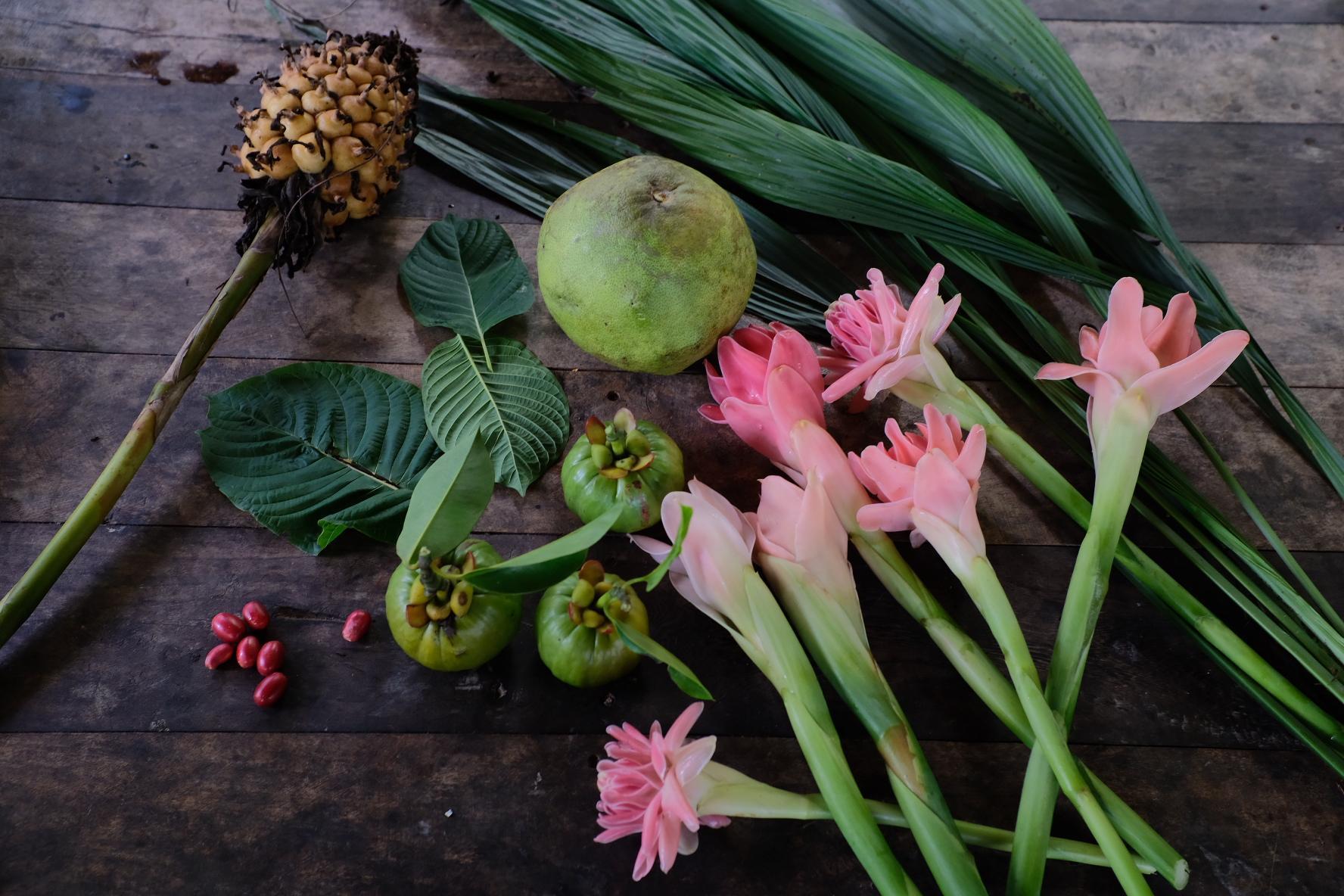
To explore the other half of the proverb, we turned inland. If the coast demands patience with the elements, the forest requires a more immediate form of survival knowledge. In local markets, we tasted the bright tang of torch ginger flower, the bitterness of kratom, and the sharp tartness of Assam fruit. For the producers, cultivating these ingredients also means navigating a militarised landscape. Foragers and agricultural workers, especially rubber tappers, who often work during the vulnerable hours before dawn, must plan around checkpoints and curfews to reach the forest and plantations. Security operations can periodically close local roads, making access to a harvest uncertain from one day to the next. In this region, engaging with the environment can invite state suspicion, forcing residents to calculate their movements against the unpredictable demands of the government.
Reading the forest for survival has deep roots in the region’s history. The forest canopy has long served as a space of refuge and resistance. The Malaya Communist Party members relied on frequent exchanges with the indigenous Orang Asli to learn what is edible in the forest. The practical skill of knowing which leaf will sour a broth, or which root will fill a stomach when access roads are suddenly closed, still shapes everyday cooking in the markets and homes we visited.
Tracing the proverb showed us that there are other timelines than those controlled through minutes and hours. There is the making of salt that depends on a sea that no longer behaves predictably. There are fish that require long periods of fermentation and regular visits. And there is a strengthening broth that finds its tanginess through many years of hiding in the jungle.
What ties these practices together is timing: of the tides, the weather, conflicts, and the forest’s own calendar of what grows, when, and where. Ingredients and techniques here are shaped as much by circumstance as by choice.
Part 2: Continuing Fieldwork Through Fermentation
Our fieldwork continued with the materials we had tasted and gathered. Moving from the landscape to jars, we combined local knowledge with our own material practice. To make pungent sataw and jengkol (stinky and bitter beans), we spoke with market vendors and followed local preservation methods. With torch ginger flower, kratom, cowa, som kaek, and miracle berries, however, we introduced lacto-fermentation, which is not commonly used for these ingredients in Thailand. Submerged in brine made with Pattani sweet salt, these ingredients came together and continued to interact with each other long after their collection. Here, new bacterial relationships that would not have existed in the forest or market formed. Because our inquiry centred on how communities navigate restricted time and space, we felt compelled to expand this metabolic conversation beyond Thailand.
Images: Our Pattani ferments. Photo: Iris Sham.
Alongside the Pattani jars, we prepared ferments from two contested geographies that are viscerally familiar and urgent to us: Hong Kong, Iris’s home, and Palestine, where Louisa spent her formative years. Both locations have taught us how people endure when their space is restricted and their time forcibly regulated. To engage more fully with the state of friction in Pattani, we brought our own experiences into material dialogue with one another. It was also an invitation for constructive discussion with local visitors and participants. A key cultural actor in Pattani shared his frustration with how people often perceive the Deep South as isolated. In fact, he explained, they are acutely aware of what is happening around them (in Iran, Palestine, Hong Kong, and elsewhere) and they discuss it regularly in their circles. We did not intend to prescribe any connection. The jars are separate from each other. They may, however, provoke generative reflections and inquiries into other contexts.
For our engagement with Hong Kong, our starting point was everyday practices of preservation and care. Using Hong Kong sea salt, we prepared salted lemons, traditionally used as a simple folk remedy for sore throats. In our work, the preserve acquired a heavier resonance, a silent meditation on the possibility of healing a city’s lost voice.
We also prepared kabees, lacto-fermented vegetables from the West Asian pantry that people have prepared since time immemorial for an uncertain future or disaster. Our salt was sourced directly from Hussam Hallak, whose father founded the last remaining Palestinian salt factory on the shores of the Dead Sea. This family perseveres against all odds: environmental, as the sea is shrinking and literally evaporating in front of their eyes; and political, due to frequent harassment by nearby settlers.
There may be a temptation to view the placing of these salted ferments as a metaphor for global solidarity. The violence that is unfolding in these places is not symbolic, however. Through the materials we brought to Pattani, we sought to viscerally share with the audience what is happening in these places.
Once dissolved in brine, the salts became active agents in the fermentation process, physically altering the ingredients at a rhythm of their own. Microbes continually reorganised themselves, negotiating with space and time. While they consumed sugars and produced acids, we waited in fearful anticipation since microbial life is invisible to us. Here is also a rather unsettling truth: They can live without us when we cannot live without them.2 Despite seemingly similar conditions and preparation methods, not all jars remained food safe and one batch developed mould. This archive is alive and continues metabolising at its own pace, driven by a biological momentum that persists independently of human intervention.
This microbial unpredictability grounded us back in the sociopolitical realities of Pattani, where regulations like the emergency decree control time through arbitrary curfews and checkpoints. Instead of trying to represent this temporal regime through symbolism, we imagined a system in which a biological, non-human timeline could operate materially, in an attempt to override the mechanical clock of the State.
Image: Salt in the Sea, Acid on the Land. installation at the Pattani Biennale 2026. Photo: Iris Sham.
Part 3: Metabolic Time vs. Standardised Time
When mineral salts and acidic brine interact with metal electrodes, they yield a small but reliable current. Using the fermentations we had prepared with ingredients and salts from Pattani, Hong Kong, and Palestine, we constructed a series of living biopowered clocks. Because we wired the electrodes directly into the fermentation vessels, the microbial metabolism that powered each clock was intimately linked to what was happening inside. Organic matter was bubbling, decaying, and transforming; yes, even moulding on the surface in the hot and humid air of Pattani.
Initially, we set the clocks at the local times of the places of origin of the ferments. Their rhythm cannot be predicted, so the ticking of the clock arms may slowly drift out of sync with one another. Ultimately, the minerals and acids are indifferent to our standardised time units. Much like the tides and the weather, they keep their own timelines.
Image: Salt in the Sea, Acid on the Land procession at the Pattani Biennale 2026. Photo: Thichakorn Plengpanich.
After installing the clocks, we led an evening procession through the streets of Pattani, pushing a second set of jars in a food cart alongside visitors of the biennale and local residents. Starting at the city’s central clocktower, with the river beside us, we imbued the jars with additional kinetic energy. Every pause, change of pace, bump, and curve on the road altered the vibrations inside the vessels. Out in the streets, rather than in the gallery, we shared an experience where visitors could taste the ferments and take the produce of these landscapes into their own bodies. “Garam di laut, asam di darat” found its completion not only inside the jars, but also albeit briefly, on the audience’s tongues. Taste offers a visceral and immediate understanding of time and transformation that cannot be grasped through visual observation alone. While we served the ferments, placing them on palm leaves or directly onto the participants’ hands, the stories we verbalised were communicated through taste, too. They became part of an intimate, shared moment lived together through taste and movement.
All of this took place within a state of emergency where the State heavily regulates mobility. Standardised units of time are undeniably useful and often necessary for coordinating everyday life and rhythms. However, they become oppressive when enforced by the State as the only objective measure and means of controlling reality. As Rasheedah Phillips argues, the imposition of timekeeping acts as a tool of control that objectifies and flattens experiential and localised notions of time.3 Just as conventional maps obscure dreams, aspirations, and human-to-nature connections, the absolute authority of the “master’s clock” obscures the diverse living temporalities that exist outside of state control, such as the slow metabolism of fermentation.
Image: Sup Communist. Photo: Iris Sham.
Epilogue
Once the communist soup had simmered long enough to be shared solemnly between students and artists, we swallowed the fragrant broth and felt a warmth spread through our bodies. Perhaps aided by that sensation, a few students took out a guitar to sing in communion. “Making art is gathering people to talk to each other,” one student said. In a region that is so heavily policed and forcibly isolated, many of the young artists find a space for expression and communal healing in art.
Art serves as a vital vehicle in the Deep South. As a friend at the Deep South Museum and Archives explained, it offers an “alternative vocabulary for feelings that words cannot describe.” Crucially, art also offers an alternative engagement with time. In a landscape governed by the rigid, linear time of emergency decrees and curfews, artistic practice carves out a temporal space where the slow, non-linear processes of creation can unfold at their own pace. The Patani art space, for instance, welcomes women from nearby towns who come regularly to spend time making art without a predetermined guideline.
Some participants who joined our procession echoed this sentiment. They described how the walk alongside the river felt like water itself: always shifting, never quite predictable.
Notes
1. Meryem-Bahia Arfaoui, “Time and the Colonial State,” trans. Chanelle Adams, The Funambulist, 21 June 2021, thefunambulist.net/magazine/article/time-and-the-colonial-state.
2. Maya Hey, “Fermentation and Delicious/Disgusting Narratives,” Food in Memory and Imagination: Space, Place, and Taste, ed. Beth Forrest and Greg de St. Maurice (Bloomsbury, 2022), p. 25.
3. Rasheedah Phillips, “Placing Time, Timing Space: Dismantling the Master's Map and Clock,” The Funambulist, 5 July 2018, thefunambulist.net/magazine/cartography-power/placing-time-timing-space-dismantling-masters-map-clock-rasheedah-phillips.