OCTOBER 8, 2026
Book Review: The Meaning Of Design In Hand
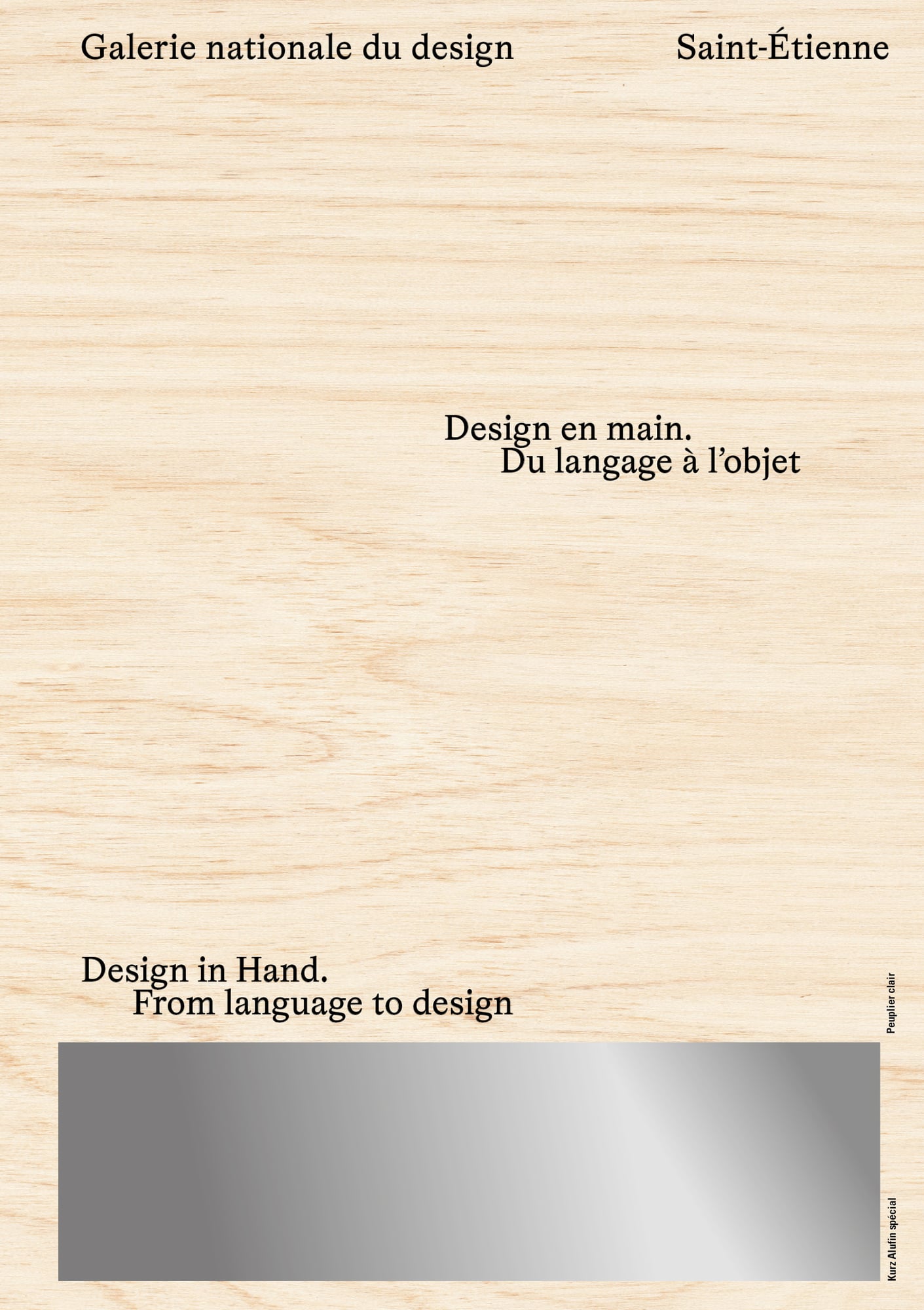
Designed by Syndicat and published by Empire Books, Design in Hand. From Language to Object is first and foremost the catalogue of the inaugural exhibition of the Galerie nationale du design in Saint-Étienne, France. It starts from six French expressions related to the “hand”: à mains nues (bare-handed), mettre la main à la pâte (taking part with one’s own hands), avoir en main (holding in hand), de main en main (circulating between hands), prendre en main (taking on) and à portée de main (within reach). These expressions are hard to translate word for word, because main in them refers both to the real hand and contains multiple layers of meaning such as action, control and transmission. The whole book uses exactly this ambiguity of language to write design history as a history of labour, use, circulation and preservation.
Part 1. The Establishment of a National Design Collection
The Galerie nationale du design opened in June 2026 at the Cité du design in Saint-Étienne, jointly promoted by the Cité du design and the Musée d’art moderne et contemporain (MAMC+). France’s design collections have long been scattered across different cities and institutions. The “national” nature of the Galerie nationale du design does not come from one central collection, but lies in organising these collections, through exhibitions and research, into a network of continuous cooperation.
Galerie nationale du design
The opening exhibition gathers nearly four hundred works, borrowed from about ten public institutions, including the Centre national des arts plastiques (Cnap), the Centre Pompidou, MAMC+, the Musée des Arts décoratifs et du Design in Bordeaux, the Musée des Arts Décoratifs in Paris, the Manufacture nationale de Sèvres, and others. Some of them are rooted in the history of modern art, some originate from local industry, the decorative arts or the national craft system. In the book, each institution tells the process by which its collection was formed, and also explains that a design object becoming “national heritage” is the result of long-term selection, preservation and interpretation.
Therefore, de main en main does not only describe objects passing between people; it can also be understood as collections flowing between institutions. National institutions, local museums, craft manufacturing systems and contemporary art networks together build the narrative of design history. What the exhibition presents is not a closed list of classics, but a method of rewriting history through collaboration.
Interpretations of Design Collections by Public Institutions
This also explains why the exhibits are so mixed. The glass table supported by bicycle wheels by Italian architect Gae Aulenti, Andrea Branzi’s lamp made of a metal pot and rice paper, French designer Philippe Starck’s lamp shaped like an M16 rifle, and Pierre Charpin’s symbiotic paintings and vases are placed side by side with Manufrance product catalogues, factory promotional photos and ordinary kitchen knives. Classic works no longer naturally occupy the centre; design also exists in production techniques, commodity systems and the movements of nameless workers.
Part 2. Hand and Language
Why does the Galerie nationale du design start from the “hand”? The “hand” here is both body and metaphor: it makes objects, operates machines, picks goods in catalogues, and also sends everyday objects into the museum. The “from language to object” of the title is not a one-way process from concept to finished product, but a back-and-forth movement in which words and matter constantly explain each other.
The Diverse Works Featured in the Exhibition
The opening essay by design historian and curator Laurence Mauderli, D’un design du langage vers un langage du design, which can be understood as “from the design of language to the language of design”, traces how the “hand” passes through handicraft, industrial production, commercial communication and contemporary design. Objects are not queued by date or type, but connected through gestures and language. A knife, a lamp or a catalogue all become entrances to observing the relationship between people and materials, machines and consumption.
Curator Laurence Mauderli traces the relationship between language and objects through history.
Mauderli pays particular attention to how language shapes our understanding of objects. Before being named, an object may be only a material, a tool or a commodity; once it enters a certain expression, it gains a new range of action and cultural position. Expressions such as “holding in hand”, “handing over” and “having in hand” not only describe the relationship between people and things, but also suggest power, responsibility and ways of use. Design therefore does not only happen at the stage of manufacturing, but also in the process of how we talk about, classify and imagine objects. Language is like an invisible hand, continuously adjusting the position of objects in society.
In her argument, design is also no longer only knowledge inside a professional field, but an organising ability that exists widely in daily life. How people arrange the kitchen, choose tools, read catalogues, maintain furniture, even how they hand an old object to the next user, all contain design judgements. This perspective makes design history move out from a lineage of a few authors and styles, and turn to the observation of gestures, habits and institutions. The subject of design also becomes more complex: besides designers, it also includes producers, sellers, users, repairers and collectors.
Part 3. Hand and Machine
In La main dans la machine / The Hand in the Machine, British anthropologist Tim Ingold argues against a common narrative of progress: as if every step forward of the machine means a step back of the human hand. He does not simply praise handwork and condemn machines, but pays attention to how the body participates in mechanical operation. In the example of the pedal-driven grinding wheel, foot, hand, stone and mechanism form a loop of perception; the maker feels the material and adjusts movements, and the machine thus becomes part of bodily activity.
Ingold borrows two concepts from design theorist David Pye, comparing workmanship of risk (making where the result carries risk and needs judgement at any moment) with workmanship of certainty (making where the result is controlled in advance). The value of manual labour is not only in “making with one’s own hands”, but also in that the maker can sense the reaction of the material and keep adjusting during the process. The machine is also not an abstract force independent from the history of labour; it equally needs human maintenance and repair.
At the end, the essay imagines the museum as a place of repair, that is, “a place for repairing and restoring connections”. This idea is especially touching: rather than sealing old machines as remains of the history of progress, it is better to learn again from them how to maintain the continuity between objects, technologies and life. What needs repair may not only be damaged objects, but also the connections between people, technology and environment that consumer culture has cut off. These views also make the discussion of the “hand” go beyond a nostalgic hymn to handicraft.
Part 4. The Heritagisation of Industrial Products
Art historian Aziza Gril-Mariotte’s essay asks further: how does an industrial product become cultural heritage? She traces the development of world expositions, public collections and company museums. The patrimonialisation she discusses is not only “collecting”, but closer to “heritagisation”: an object originally used for production and consumption, through institutional selection, academic interpretation and exhibition display, gradually gains the identity of cultural heritage. What museums preserve is not only objects, but also a certain era’s understanding of industry, labour and daily life.
Heritagisation itself is also a process completed together by many “hands”. An industrial product entering the museum from the factory is not simply moved from the production line to the display case, but goes through selection, registration, transport, restoration, photography, research and narration. Every step changes the identity of the object: it is no longer only a commodity, and not only an eliminated tool, but becomes historical material that can be viewed, compared and reinterpreted.
The problem Gril-Mariotte discusses also tells us how display itself is shaping the public’s understanding of design. The exhibition gathers objects originally scattered in factories, shops and homes, bringing them into a new visibility. What visitors see is not the whole history of the objects, but a version of history after institutional arrangement. Precisely because of this, curating must keep asking: whose labour is shown? Whose experience is omitted? Which objects are considered worth preserving, and who has the power to decide their value?
Part 5. Design as Curatorial Action
British design curator Donna Loveday turns the question to curatorial practice. The curator is not only the guardian of a collection, but can also be a researcher, mediator, maker or a provocateur who actively asks questions. An exhibition is a selection that keeps happening.
Donna Loveday extends the “hand” from the object itself to the act of curating.
Loveday’s view extends the “hand” from the object itself to the curatorial action. By touching archives, comparing objects, organising space and designing viewing routes, the curator connects scattered materials; at the same time, they must also be aware that any connection comes with choices. An exhibition does not present facts exactly as they are, but intervenes in history in a concrete form. The curator’s hand is building the narrative, and also exposing the limits of the narrative.
Therefore, collecting and curating are not administrative work outside design history, but the conditions for design history to exist. They decide which experiences can continue to be passed on to future audiences. If design is a way of organising materials, actions and life, then the museum is equally designing memory.
Part 6. Good Design
Designers in Dialogue, on the purple paper pages of the book, brings the discussion from design history, collecting systems and curatorial methods back to design practice. Several designers hold dialogues around the same questions: what constitutes good design? Can these standards survive technological and social change? How does design respond to environmental problems? And can historical knowledge help designers deal with present needs? These questions and answers do not try to sum up a unified conclusion, but put different, even contradictory, positions side by side.
Italian design master Michele De Lucchi
Italian design master Michele De Lucchi thinks that good design has no ready-made formula, but should make technology emotionally closer to the user. He opposes updating for the sake of updating, and advocates responding to environmental problems by transforming existing buildings, reusing materials and reducing useless production. For him, the value of design is not only shown in the creation of new objects, but also in whether the designer can re-understand and use things that already exist.
British industrial designer Jasper Morrison sums up good design as suitable materials, value, atmosphere and physical and visual longevity. He points out that the market and media often pay more attention to short-term novelty, but ignore those objects that can be used for a long time and do not overly emphasise their own existence. Whether a design is successful cannot only be judged by whether it is eye-catching enough when it first appears, but also by whether it can enter daily life and gradually show its value in use.
Belgian design duo Studio Unfold starts from the relationship between digital manufacturing and traditional craft, emphasising that innovation does not mean breaking with history. New production tools still contain traces left by earlier technologies, bodily movements and material knowledge. Digital manufacturing, local craft, material memory and ecological responsibility can form a continuum, that is, a whole that keeps continuing and changing. The designer’s work is not to erase the past with new technology, but to identify the connections between different knowledge, and then bring these connections into new conditions of production.
The radically different ways designers understand good design.
The focus of these answers differs, but together they question the idea of equating “innovation” with making novel objects. Good design does not necessarily appear as a never-seen-before form; it may also be reflected in repair, transformation, extending the time of use, or reactivating existing knowledge. These dialogues also give the “hand” another layer of meaning. The hand is responsible not only for making, but also for choosing, judging, adjusting and continuing. The designer does not stand outside history to create the future, but works within existing materials, technologies and social relations.
Part 7. The Book as an Extension of the Hand
The Paris graphic design studio Syndicat puts the polyphonic structure of the exhibition into the form of the book. The studio was founded in 2012 by Sacha Léopold and François Havegeer, who also founded Empire, the publisher of this book. They have long been involved in art publishing and exhibition design, and value the relationship between typeface, printing and material. The form of this book is not packaging after the fact, but an extension of the curatorial method.
The wood-grain cover is close to a board still waiting to be processed; the six French phrases are broken into letters and arranged along the page edges, becoming navigation while flipping through; the designer interviews are printed on purple pages. French and English are not always divided into left and right columns, but move between the main text, the margins and the white space. The reader needs to turn their eyes, look for paragraphs and keep turning pages. A book discussing the “hand” thus becomes an object that must be picked up and operated.
This way of reading also responds to the book’s discussion of collecting and curating. The reader is not facing a set of already arranged knowledge, but chooses, moves and connects between pages, building their own viewing route like a curator. The pages become exhibition halls, and catalogues, images, quotations and white space form different display units; turning pages is similar to moving between objects. Design here is not only a shell for delivering content, but lets readers personally experience the process of classifying, misplacing and recombining.
Different institutions, authors, languages and objects are not flattened by a neutral layout, but keep their own voices in the book. This could also be said to be a risk: six expressions about the “hand” can hold almost any object, and sometimes inevitably become beautiful curatorial rhetoric; the frequent switching between French and English, essays, interviews and images also makes the rhythm not always coherent. But this unevenness and the collaborative way of the exhibition are inside and outside of each other, giving reading itself a sense of searching and reconnecting.
The importance of Design in Hand is in correcting an illusion about design: design seems to be born in the head of a master, realised automatically in the factory, and finally comes to the consumer as a flawless finished product. In fact, behind every object is a relay of hands, including conceiving, making, operating, buying, maintaining, collecting and reinterpreting. Even today, with automation and artificial intelligence expanding continuously, the hand has not disappeared from the machine; it only needs more to be seen, and to take responsibility for its own choices.
*Originally written in Chinese by Rui Hua and published by IDEAT. English translation assisted by AI.