SEPTEMBER 24, 2026
Artist Talk Review: "Salt Of The Sea, Acid Of The Land, Meeting In A Single Pot" With Iris Sham
How does food become a lens for understanding the world? For artist and researcher Iris Sham Sin Hang, the answer goes far beyond simply presenting “food as art.” Her creative journey began in her teenage years with photography, which she used as a language to interpret and engage with her surroundings. After studying political science and law, her focus shifted toward issues of rights, identity, and power structures. Since the pandemic, food has evolved into a core part of her practice. Through taste, ingredients, fermentation, and cooking, she explores complex themes that text and theory alone cannot fully articulate.
In this conversation, Iris discusses SALT IN THE SEA, ACID ON THE LAND, her recent work featured at the Pattani Biennale, and shares insights from her fieldwork in southern Thailand. She also reflects on Hong Kong and Palestine, photography, law, and the prison system, while touching on her own childhood memories surrounding food. Fermentation serves as a unifying thread: it acts simultaneously as a physical material and a concept of time, a method of archival preservation, and a practice of reclaiming autonomy under constrained conditions.
When these experiences finally connect back to the audience’s own culinary memories, whether of fermented bean curd, sour fish soup, tomato and egg, chocolate, or pickled radish, these “living archives” extend beyond the artwork itself. They weave into each person’s unique emotional memory, ultimately coming together in a single pot.
01|Fermentation as Method: From the Moving Image to Food
Photography has been Iris’s language of choice since her teenage years, serving as her primary tool to both comprehend and converse with the world. Her subsequent studies in politics and law brought questions of rights, identity, and structural power to the forefront of her practice. After graduation, however, she discovered a deeper affinity for visual rather than purely textual thinking, using imagery to probe the boundaries of rights and the making of identity. If her legal training taught her to dismantle arguments and interrogate systemic operations, photography allows her to anchor those intellectual inquiries in the tangible realities of people, places, and lived experience.
In the wake of the pandemic, food gradually became a core component of her artistic practice. This evolution was not a retreat from political or legal discourse, but an alternative entry point into the same foundational questions. She observed that culinary processes and photography are bound by an essential, shared temporality. Neither medium yields instantaneous results; both require patience, trust, and a deliberate deceleration. Though photography is typically understood as the seizure of a decisive moment, Iris is preoccupied with the extended duration that precedes it: occupying a space, without predetermined expectations, and simply observing until something significant emerges. Fermentation embodies this exact rhythm. It resists being rushed; matter must pass through time, microbial ecosystems must run their course, and the artist is left only to engineer the environment, wait, and witness the change.
In this light, food is not simply an add-on to her visual work, but a seamless continuation of its core philosophy. It lends a tactile permanence to the intimate, everyday experiences that grand histories tend to forget. Rather than confronting a place through abstract political frameworks, one can begin with a simple piece of salt, a humble plant, a simmering pot of soup, or the patient act of preservation. Food itself bears witness to life unfolding and fermentation becomes the vessel where time, environment, human touch, and shared relationships merge entirely.
Oh My Dear Swallows,© Iris Sham Sin Hang
02|Entering Pattani: Beyond Violence, Toward the Texture of the Everyday Life
The starting point for this research is Pattani, located in the deep south of Thailand. Situated near the Thai-Malaysian border, the region shares geographical ties with Penang and Kuala Lumpur that are, in many ways, more direct than its connections to the central Thai state. Historically an independent Malay Muslim sultanate, Pattani is anchored by deep cultural, linguistic, and religious roots in the Malay Peninsula. In the early twentieth century, it was incorporated into Siam (present-day Thailand), and following a 1909 treaty between Britain and Siam, the former sultanate’s territory was partitioned between modern-day Thailand and Malaysia. This fractured history has left behind tensions over identity that persist today. Although the local population is predominantly Muslim and relies on Malay as a vital everyday language, this culture has faced continual suppression. Since 2004, the Deep South has been defined by armed conflict, martial law, and military oversight; indeed, upon entering Pattani, the first sight to greet a visitor is often a military checkpoint.
Iris and her collaborator, Louisa, first arrived in the region following an invitation to the Pattani Biennale. During their initial research, they discovered that writings about the Deep South was scarce. For decades, the area has been largely inaccessible to outsiders, and what little narrative does exist tends to fixate heavily on conflict and violence. Upon arriving, however, Iris realized that approaching Pattani solely through this lens risked reducing the region to a predetermined political trope. Instead, she immersed herself in the community: visiting the sea and local markets, sharing meals, and observing the rhythms of everyday life. She wanted to understand the lived reality of the conflict: Where does violence actually occur, and whose lives does it disrupt? More importantly, how do people eat, work, preserve food, and sustain their daily rhythms in an environment defined by uncertainty?
Pattani River, Pattani market © Iris Sham Sin Hang
These observations naturally drew her and Louisa to Pattani’s rich culture of fermentation. Along the coast, they discovered budu, a profoundly significant fish sauce in Malay Peninsula cultures crafted by fermenting fish with salt. During its preparation, the fish are never rinsed in freshwater; instead, their innards, scales, and bones are left intact as the mixture ferments under the sun and heat for roughly nine months. They also encountered stinky beans alongside torch ginger, kratom, and a sour leaf used as a local substitute for lime. Torch ginger, a fragrant flower milder than the root itself, is a cornerstone spice across southern Thailand and the Malay Peninsula. Meanwhile, kratom reveals a complex history: though long prohibited in Thailand before its 2021 legalization, local farmers had continuously relied on it for pain relief and stamina. For Iris, these ingredients are not merely “local specialties” meant for neat categorization; rather, they are the enduring traces of a region’s deep, lived history.
Fermentation embodies time, community relationships, environmental understanding, and crucially a form of survival knowledge. Different foods operate on distinct temporal scales, with humans serving as just one of many actors in the process. More importantly, when specific ingredients are unavailable, what do people use instead? How do communities innovate when resources are scarce? In this context, substitution is not merely a desperate compromise; it is an active form of knowledge and a testament to creative capacity.
Ultimately, she decided to understand Pattani through the lens of a “fermenting jar.” Fermentation became her entry point into the region’s complex reality.
Stinky beans, torch ginger, kratom leaf and sour leaf © Iris Sham Sin Hang
03|“Salt in the Sea, Acid on the Land, All Meeting in a Single Pot”
For the Pattani Biennale, Iris and Louisa created SALT IN THE SEA, ACID ON THE LAND. The title is drawn from a local Malay proverb in Pattani: salt from the sea and acid from the land, all meeting in a single pot.
This proverb provides the foundational structure for the artwork itself. Salt is drawn from the sea, and acid emerges from the land. Although they originate in entirely different environments, they eventually converge in the same pot.
Iris reads the phrase as a metaphor for encounter, and develops it further into a framework for solidarity across geographies.
She situates Pattani, Hong Kong, and Palestine within a shared conceptual structure. However, she stresses that this is not an attempt to reduce the three regions to mere “similar experiences of oppression.” On the contrary, she remains deeply wary of the flattening effect that the word “solidarity” can often produce.
While the historical contexts of Pattani, Hong Kong, and Palestine are distinct,, they are linked by shared experiences of drawn borders, contested identities, and daily existence interrupted by external power. To flatten the nuanced and complex realities of these locales merely for the sake of claiming “solidarity” is, in itself, to enact another form of violence.
What matters, therefore, is allowing elements from different places to encounter one another while keeping their differences intact. Much like salt and acid meeting in a single pot, each retains its distinct flavor. A shared ecology is never a pre-existing “solidarity”; rather, it is something that demands time, specific conditions, and careful cultivation before it can gradually take root.
She therefore introduces living, transforming materials into the installation and performance, allowing the artwork itself to embody a “solidarity in the making.” Rather than presenting a finished state, the work is a continuous becoming—an ongoing process. The performance weaves together ingredients, stories, and voices from diverse geographies, bringing the weight of multi-generational conflict directly into the room. Through this shared experience, she hopes to imagine a different future: one that guarantees not just safety, but dignity.
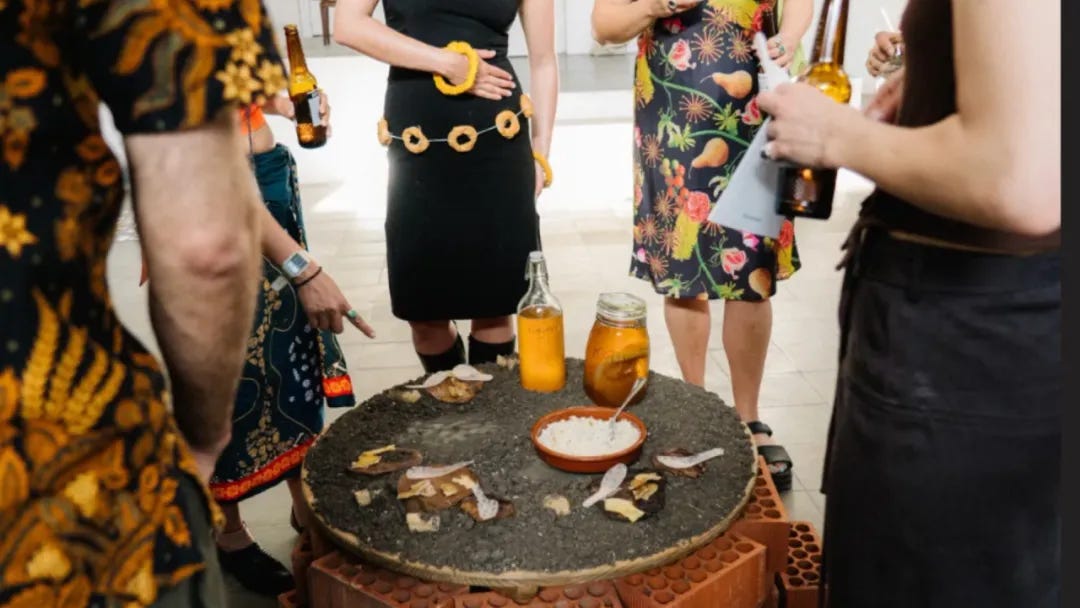
Iris weaves salt, plants, ferments, sounds, and regional food into a performance that unfolds along the Pattani River. Drawing on the cultural significance of Thailand’s street-food and night-market economies, she employs a traditional pushcart as a locally resonant vessel for the work. The experience begins with a moment of silence, after which participants taste a mouthful of Pattani’s salt Because Pattani sits at the exact confluence of river and sea, this local harvest is less saline than typical sea salt and is affectionately known as “sweet salt.” Cultivated in the last remaining salt farm on the entire Malay Peninsula, eating this salt becomes a symbolic act of letting the sea enter the body. From there, participants walk along the riverbanks, encountering distinct food, soundscapes, and local narratives along the way.
"Salt of the Sea, Acid of the Land" © Iris Sham Sin Hang
The first stop features fermented torch ginger, accompanied by an audio recording of locals describing the process of making budu. One line from the recording carries particular weight: sometimes the food must be brought out into the sun to aid fermentation; at other times, one can do nothing but wait and let the elements complete their work. In this context, “waiting” is not a passive act. It is a profound form of local knowledge, and ultimately, a way of life.
The selection of the Pattani River as the performance route is intentional. Because the region has a history of severe flooding, the river embodies both the vitality and the precarity of local life. As participants walk along its banks eating actively fermenting foods, their bodies physically integrate with the water, salt, climate, and temporality of the landscape. In this context, torch ginger ceases to be merely an ingredient; it becomes a “fated encounter.” Salt meets land, microorganisms multiply, materials continuously transform, and within that flux, they carve out their own space. The artwork, therefore, is never a “completed” object. It is a living, continuously generating ecology.
From Pattani’s salt to Hong Kong’s salt,the second stop is Hong Kong.
Iris ferments local Hong Kong lemons using Hong Kong sea salt, transforming a single mouthful of salted lemon into a gateway to another history. Today, it is difficult to associate the city with salt farms. Yet centuries ago, salt fields dotted Lantau Island and other areas, making salt a major pillar of Hong Kong’s production and trade. As colonial rule gradually repositioned the city into a global hub for finance and commerce, agriculture and salt-making were sidelined from its developmental trajectory. Salted lemon, therefore, preserves more than just a flavor; it archives a forgotten history of production, long buried beneath the city’s urban expansion. At the same time, it remains a tangible expression of care in everyday Hong Kong life, traditionally used to soothe a sore throat.
In Iris’s work, the salted lemon carries a dual significance: it acts as both a form of resistance and a method of healing. In contexts where collective expression has been stifled, this simple ferment seems to hold onto a resonance that the body instinctively remembers.
"Salt of the Sea, Acid of the Land" © Iris Sham Sin Hang
At the third stop, the journey shifts from the salts of Pattani and Hong Kong to the salt of Palestine. This transition is accompanied by Kabees, fermented vegetable commonly seen throughout the Middle East, including Palestine. The salt used here is sourced from the last functioning salt pan in Palestine. Situated by the Dead Sea, it marks the most saline point of the entire performance, creating a stark contrast with Pattani’s subtle “sweet salt.” Though encircled by Israeli-occupied territory, this salt farm has been in continuous operation since 1946, with its harvests today exported primarily to European and Western markets.
Countless efforts have been made to force these salt-makers out of Palestine, yet they remain steadfast. They have witnessed the literal shrinking of both the land and the Dead Sea; to persist and envision a future amidst such ecological and political erosion requires immense resilience. This endurance resonates deeply with a reflection Iris recorded in Pattani: the essence of a locale and the inheritance of past generations constitute a vital, sustaining bond. Even under the threat of inevitable erasure, the impulse is to resist the timeline of loss. If told a tradition or a place will vanish in five years, the collective response is a determination to sustain it for another ten.
Whether in Palestine, Pattani, or Hong Kong, these salt-makers share the same quiet defiance, an absolute refusal to let go. They are anchoring themselves to traditions born from the soil and sea over hundreds of years. Ultimately, salt is what allows these histories to keep happening. It acts as the vessel that preserves their memory and carries the quiet force of their survival onward.
04|Temporal Interventions: Fermentation as a Living Archive
"Salt of the Sea, Acid of the Land" installation view © Iris Sham Sin Hang
The installation accompanying the performance centers on three clocks. Instead of ordinary batteries, they are powered entirely by electrical currents generated through fermentation. Sealed within containers are fermenting materials, regional plants, and brine. As microorganisms multiply and the acidity gradually shifts, a current is produced between the salt and metal plates, providing the energy that drives the clocks. These three timepieces are set to the respective local times of Pattani, Hong Kong, and Palestine.
What is essential, however, is that this temporality is no longer subject to human regulation. Yielding to the fluctuations of the bio-electric current, the clocks may accelerate, decelerate, or cease ticking altogether. The installation ultimately interrogates our relationship with time: whose rhythm dictates our existence? Is the standard, mechanical time we observe merely an apparatus of the capitalist system? In contrast, does the metabolic time felt by our physical bodies possess a sovereign, inherent rhythm?
Iris conceptualizes these fermenting substances as “living archives.” Rejecting the static preservation of the traditional white cube, these materials remain in a state of perpetual flux throughout the exhibition’s duration. The sensory experience is inherently ephemeral: the ferments consumed at the opening will inevitably alter in flavor, growing increasingly acidic or cultivating mold, while the bio-powered clocks shift their tempo in response to ambient climate conditions. Upon her return to Pattani in August, ferments initiated in May had developed a dense layer of mold. In a conventional institutional setting, such decay might imply the work has “gone bad”; in Iris’s practice, this unscripted biological progression is the very essence of the piece.
This unfinished state directly mirrors the reality of Pattani itself. Iris points out that the region’s conflicts have not truly ended; tensions surrounding identity persist, and the future remains completely undetermined. Rather than attempting to summarize the place through a closed, stable artwork, she chooses to let the installation inhabit a shared state of uncertainty. It is a process that demands patience and accepts risk—one that is always liable to grow mold, spoil, or turn foul.
05|When Photography Begins to Ferment
This conceptualization of time is inextricably linked to Iris’s photographic practice. She rejects the notion of photography as the mere freezing of an instant, approaching it instead through the conceptual logic of fermentation. It requires a sustained immersion in a locale, cultivating patience for that which has not yet materialized. Within her work, the camera serves as an instrument of both mourning and commemoration. While her childhood impulse was to use photography to grasp the ephemeral, her current practice views it as an act of archiving what is already gone. This shared temporality of loss and slow transformation forms the fundamental affinity between her photography and her biological art.
In her view, fermentation is slowly fading into a lost art. It demands time and patience—qualities that modern society, with its aversion to slow, uncontrollable processes, finds increasingly difficult to accommodate. Fermentation invites mold, dirt, and pungent odors; it is entirely beyond human control, traits that contemporary culture is quick to dismiss as “unpresentable.” Yet she remains committed to sustaining this practice, eager to discover what it can still pass down and how future possibilities, things waiting to germinate anew, might be preserved. Ultimately, for her, both fermentation and photography are deeply bound up in this very specific temporality.
Recently, her practice has expanded to include sustainable darkroom methodologies. Forgoing conventional chemical developers, she formulates organic, plant-based alternatives. A photograph of ginger, for instance, is processed using a developer derived from ginger skin, flowers, and the entire plant, effectively folding the subject’s biological matter back into its own image-making process.
For her, this practice is itself a form of resistance.
This resistance is rooted in a renewed attention to the mechanics of image production. In contemporary practice, exposed film is routinely outsourced to commercial labs; though inherently slower than digital capture, it has nonetheless been streamlined into a frictionless mode of consumption. Her practice intervenes by interrogating how a photograph comes into being, moving beyond visual representation to ask how the print and its substrate are physically constructed. By rendering these invisible methodologies visible, the image transcends its status as a mere visual outcome, functioning instead as a repository of concrete material traces. It is this profound engagement with materiality that anchors her darkroom practice.
Last year in Madrid, she built an entire installation out of ginger. Photographs were buried beneath the earth, acting as a quiet metaphor. The work unfolded around this single rhizome, offering participants handmade candied and pickled ginger alongside ginger fried rice. She even shaped a spoon from rice paper so that, once the food was finished, the utensil itself could simply be eaten.
Ginger carries further resonance in her practice through its association with the somatic experience of motherhood. A staple of traditional postpartum care, it is an accessible yet highly specific, material ingredient. Following her birth, her mother consumed ginger fried rice to restore her kidney function, inextricably linking the botanical to her personal lineage. In this work, she intentionally folds the concept of maternal identity into the broader framework of the piece. Pushing the boundaries of the medium, the ginger-based photographic developer was entirely potable, and participants were invited to ingest it.
One, Double-Hearted,SOUPERNATURAL Madrid 2025,Exhibition photos courtesy of Maru Serrano
06|Food Is the Most Honest Evidence
As her practice evolved, Iris recognized that her shift from food and political science toward food-based inquiry was not an abandonment of her academic foundation. On the contrary, she systematically transplanted a rigorous legal analysis of power relations into the domestic space of the kitchen and the agrarian field.
Her legal training taught her how to dismantle arguments, interrogate power structures, and question the fundamental operations of institutions. Yet, both law and art can often feel detached from everyday lived experience, relying on abstract rights and theoretical concepts. Food is entirely different. Everyone eats; it demands no specialized vocabulary to be understood. Furthermore, she reflects on how, in Chinese families, parents rarely say “I love you” directly. Instead, they ask, “Have you eaten?” “Was today’s meal good?” “Who did you eat with?” For Iris, this culinary attentiveness is itself a profound expression of love.
This is why she often refers to food as “the most honest evidence.” What we choose to eat, how we preserve it, whether relying on a mechanical refrigerator or the slow life of fermentation, and the economic decision of whether to bring village goods to a wider market, all tell a story. The journey of produce from a farmer’s hands to a supermarket aisle, the geopolitical borders a nation opens or closes to certain ingredients, and the systemic barriers deciding whose crops are granted organic certification while others are excluded: all of these factors are fundamentally dictated by relations of power.
07|Sup Communist: An Alternative Production of the Archive
Among her food research in Pattani and southern Thailand, the most emblematic discovery is a dish known locally as “communist soup” or “daliwan”. Iris first encountered the unfamiliar leaf used in the broth at a local market. Upon further investigation, she discovered that this plant was historically used to make soup deep in the forests along the southern Thai-Malay border, serving as a substitute for the lime that foragers could not access.
She later learned from her curator that this soup was never meant to be an isolated dish. Originally, it was prepared for a collective, intended to be shared rather than ordered and eaten alone in a restaurant. Its sourness does not hit the palate immediately; instead, it is slowly released only through the physical act of chewing the leaves. The ingredients themselves carry traces of intersecting cultures, blending elements like lemongrass with spices typical of Chinese braising liquids. For Iris, this soup functions as a “fluid archive.” It does not need to be written down; every time it is cooked anew, the collective memory remains alive within it, still holding a quiet posture of resistance.
She further links this concept of “substitution” to her research on prison food from the previous year. In highly restricted environments, individuals are stripped not only of their physical freedom but often of their fundamental right to choose and prepare their own meals. Yet, even under such severe constraints, people still manage to use extremely limited materials to recreate familiar flavors and forge their own tools. In a previous edible performance, she created a butter candle using toilet paper as a wick—a piece that burned for exactly twenty minutes. This work directly referenced the story of a Palestinian political prisoner who used toilet paper to ignite a makeshift fire to brew coffee inside an Israeli prison.
“Substitution,” therefore, should not be viewed as a compromise or an inferior alternative. Instead, it is a profound expression of creativity, a distinct form of knowledge, and a fierce will to self-determine. Iris is careful to emphasize that this capacity must not be romanticized, nor dismissed merely as a “clever trick” born out of poverty or deprivation. Above all, it is a deliberate practice of asserting autonomy within the tightest of constraints.
Sup Komunis © Iris Sham Sin Hang
08|Rootedness: When Food Leaves the Place It Came From
If the concept of “substitution” revealed to Iris how people forge new possibilities within strict constraints, her time in southern Thailand impressed upon her with unprecedented force the importance of “rootedness.” It was here she felt just how inextricably the meaning of a food is bound to the specific place from which it emerges.
Having lived in the highly globalized environment of Hong Kong, where goods from almost anywhere in the world are readily available, she had rarely felt that a food could only be truly understood in its place of origin. However, her time in southern Thailand made her realize that some foods simply cannot be uprooted and relocated. Once budu is removed from the living context of southern Thai and Malay culture, it struggles to remain the same entity. The same is true of torch ginger. As a wild plant, once it is severed from its original ecological network, it inherently resists integration into the global market.
She recalls eating torch ginger flowers for the first time several years ago at a fine restaurant. At the time, she noted that the meal was excellent and the service impeccable, but she retained absolutely no memory of the ginger itself. In stark contrast, it was amid the unassuming, even chaotic food stalls of southern Thailand that she truly tasted—and remembered—torch ginger for the first time. This juxtaposition made her realize that when a food is severed from its native network and transformed into a global commodity — packaged, transported, replicated, and mass-produced—it can still be consumed, admired, and praised. Yet, it loses its ability to truly anchor itself within a person’s body and memory.
This sense of rootedness is vividly reflected in the local villagers’ attitudes toward budu. Many are unwilling to take it into the city to sell. For them, the ferment belongs first and foremost to their village and their daily life; it does not need to become just another commodity for outside consumption. This refusal to export their food is not a rejection of commerce, but rather a defense of local subjectivity. It is a quiet assertion that what belongs to the land, what can be taken away, and what must remain should not be dictated solely by the market.
It is here, too, that the relationship between food and identity becomes increasingly complex. For Iris, globalization does more than simply accelerate the circulation of ingredients; it actively repackages highly specific local knowledge into upscale consumer goods. As a result, a food can become more expensive while simultaneously becoming much harder to truly remember. Ultimately, the central question is not whether a food can be transported elsewhere, but rather: once it has been severed from its native soil, climate, labor, and social relationships, what exactly are we still eating?
09|When Food Becomes a Weapon
Iris does not believe that food is inherently a tool of connection. On the contrary, the deeper she goes into her research on food, the more she sees that food can also become a weapon.
During times of conflict, essentials like grain, water, salt, and medicine are easily weaponized through blockade. Rather than causing direct harm through guns or bombs, this tactic operates by depriving communities of basic sustenance, rendering them isolated and helpless. She draws a parallel between the salt farmers and fishermen of Pattani and the salt farmers of Palestine. In both regions, these individuals require extraordinary endurance and patience just to sustain the daily rhythms of their lives, quietly carving out a small space of autonomy amidst harsh political realities.
Thus, when food is weaponized, the simple acts of eating together, exchanging recipes, and sharing knowledge about staple ingredients become profoundly important. Figuring out what to use when there is seemingly nothing left is a vital act of survival. In this context, waiting together for a ferment to mature becomes more than just a culinary technique for preservation and flavor. It becomes a shared practice of resilience.
She does not view this practice as a tool for dismantling macro-level systems. She acknowledges that against such enormous structures, individuals may not be able to enact sweeping change. However, they can still actively carve out and protect a space at the scale of everyday life. This is a space where people can finally slow down, build mutual trust, and rely on the quiet work of microorganisms to help ferment and preserve their food.
In this context, “salt in the sea, acid on the land” resists functioning as a reductive metaphor for conflict resolution. Iris explicitly rejects the utopian notion that communal consumption can seamlessly dissolve geopolitical friction, or that a shared meal can neutralize historical trauma. However, she centers the persistence of human agency: even while bearing profound systemic wounds, and even when sustenance has been deployed as an instrument of violence, individuals retain the radical capacity to convene at a shared table.
10|Care Is Not Gentleness, but Sustained Investment
At the end of the talk, Iris spoke of care.
For Iris, care extends far beyond the watchful tending of a fermenting jar. It is equally about nurturing relationships that are willing to sit and listen, honoring the slow passage of time spent together, and keeping alive those unwritten family recipes and memories that history overlooked, yet have somehow been passed down from one generation to the next.
Crucially, she insists that care is neither a gentle nor a passive gesture; it is an act of rigorous will and continuous labor. Drawing on her own practice of nukazuke fermentation, she notes that the culture demands daily attentiveness—a brief period of neglect risks total spoilage. Regardless of temporal pressures, it requires vigilant custody. This dynamic extends directly to interpersonal relationships and cultural memory, both of which face inevitable decay without sustained, active investment.
She also connects this ethos of “care” directly to her approach to fieldwork. Entering a place is never a matter of simply arriving to extract information; rather, it is about cultivating the conditions necessary for local people to know you are genuinely willing to listen. The reason she has always sought out personal narratives is her firm belief that an intimate, singular story can stand on equal footing with grand historical accounts. A personal story should never be erased simply because a sweeping narrative of history demands it.
Thus, her aim is not to use an individual’s story merely to prop up a political argument. Instead, through a single person, a steaming bowl of soup, or a lingering taste, she seeks to transform distant political issues, once seemingly unrelated to our daily lives, into visceral, perceptible memories that stay with us.
Ultimately, she reflects that in an increasingly turbulent and unstable world, care, gentleness, and resilience are far from signs of weakness. Practiced every day, these quiet acts accumulate, bit by bit, into a profound kind of strength. Passing down a recipe, keeping a ferment alive, or brewing a simple bowl of soup—these acts of care are themselves artistic practices, lying at the very heart of what art can be. They may not instantly solve the world’s problems, but art retains the power to remember specific people and their stories, refusing ever to let them go.